â€å“from Plato to Podcasting and Back Again Lydia French
"Is Aristotle a person, or is he a subject that you lot study?" This is a question from my youngest son, a star, a tap-dancer, almost viii, standing beside me in our living room as I conduct a Zoom class for my undergraduates. He's get expert at Zoom over the terminal few weeks, as many have; he and his brother use information technology themselves to connect with their ain New York Urban center public school teachers. He'southward taken to regarding my classes as his personal audience: he has dressed upward every bit Batman in three unlike capes over the last few weeks, for the thrill of applause. Today, he'south trying to impress my metaphysics class, all four of them, on our optional alive chat, which is supposed to answer questions left over from lecture videos and discussion boards. He succeeds. I explain to my extremely patient and long-suffering academy students: the way my attention works is that I tin't help trying to parse my son's explosively sudden question as metaphysical distinction first, earlier dragging myself back to their question near whether the report of metaphysics, according to Aristotle, ends in the contemplation of the showtime crusade, God. They laugh. They are kind, and intellectually forgiving enough to recognize that both questions, theirs and the second grader's, are metaphysically interesting; and permit'south exist honest, his antics are calculation a human bear on.
Aristotle is both a person and a subject you can study, if you desire. I am a university professor in a philosophy section in Queens, New York, where my job (and lucky I was to get it) is to try to explicate aboriginal, existential, and political philosophy to patient yet harassed undergrads. The students must pass my core courses in gild to graduate into jobs in pharmacy, education, homeland security.
They're the best students I've ever taught. Non on paper – the schools they went to aren't considered to be as impressive as the fancy prep schools that produced the oft rather nihilistic honors students I taught while finishing my PhD – just they take a moral seriousness to them, an immediacy in caring virtually philosophy, if they care at all, that is greatly soothing to my spirit.
I'm worried nigh them: about two thirds are doing some kind of work in my classes right at present, and one third is not. I am non certain how long the two thirds will be able to sustain their interest, their internet beak, their devices, their wellness, their parents' rent. We're supposed to get for v more weeks.
I too am alarmed about my ii elementary-schoolhouse sons, who are hitting my hand exactly right now as I attempt to stop them from stopping the Wind in the Willows bootleg audiobook they are listening to while I write this, because the feed said the word ass, which they believe to exist, univocally, a bad word. I will not be able to persuade them otherwise. Their schoolhouse stopped holding in-person classes 7 weeks agone; 6 weeks ago, I took on a 2nd task of elementary school tutoring assistant and learning inability specialist.
Fortunately, this is a job I've washed before, and it was by far the all-time preparation for university teaching I've ever had. Grad school is bang-up for teaching you how to be a scholar of Aristotle, of Plato, of Beauvoir; simply more than elusive is the pull a fast one on of explaining something of what these people are thinking to people who would in truth be willing to care, if they could catch the tail end of something relevant to their concerns.
I can do both these jobs. But can I practice them both at once?
I can practise both these jobs. Merely tin I do them both at once? Each requires precisely the same window of time and totality of attention, at the same fourth dimension and in the same respect. In metaphysics, this is a task for the principle of non-contradiction, which is supposed to exist unbreakable: the same affair can't be and not be at the same time in the same respect. Right now I am breaking this law; or rather it, being unbreakable, is breaking me.
When it first became clear that people with kids at home were going to be participating in this grand educational experiment, loosely designated "homeschooling," the internet reactions were halfway betwixt generous and grandiose. So many, many brilliant people have dedicated fourth dimension to quickly drawn-up cyberspace projects, and so many of them have the real goodwill and apprehending to support it: the author of the Dove books, Mo Willems, is giving daily drawing lessons; Levar Burton, of Reading Rainbow and Roots, is doing reading-aloud sessions for several dissimilar age-grouping tiers of readers; and Patrick Stewart is blessing us all with a sonnet a day. The Penn Museum of archeology is offering "at-domicile anthropology" for kids! Information technology'southward and then much, and it's so generous. It's as well all as well much.
Advice, tips, fun activities, new websites, crazy fun things you can attempt; I've forgotten one-half of the cracking things I've run across already; whereas the one thing I could really use is a room of my ain, soundproof, with a lock. I'm non getting one. That's OK. I'm non sorry to be getting extra hugs every 7.eight minutes from my youngest, when he remembers again I'm just in the next room, and so, huggable.
But the electric current impossibilities are likewise a grave temptation for our productivity-inclined demons; demons nosotros knew almost before, but somehow now, when it's even more obvious they are whispering treason, many of usa have even less of the power to withstand. In early days, that is, mid-March, I saw a series of tweets from my fellow academics/parents, who were inspired by the thought of homeschooling to brainstorm to teach their young children how to count in aboriginal Mayan numbers (base of operations 20). Is this action fun? Yes! Intellectually fascinating? About certainly. Is information technology something to drag my attending over to correct now, start to acquire for myself, then attempt to get my children to focus on? Admittedly Not. To me it seems fifty-fifty more than inexplicable and faraway than the being of being.
The problem is that what my children and I are doing right at present is not school at home. Information technology's not homeschool, or fifty-fifty unschool, the kind of full-anarchy-learning situation I used to fantasize about when I was bored to death by loftier school. You may have heard that the word school, scholê, means leisure, the real and all-time kind of attention where you get to follow all your most idle wondering, on your ain terms, with the comfortable groundwork sense of having, after all, all the fourth dimension in the world.
Allow children larn past play, Socrates counsels Plato's older brothers.
Such self-directed playfulness, of course, could simply already be schoolhouse; it'due south fundamental to the arroyo to learning that Maria Montessori, Friedrich Fröbel (whose work influenced the Bruderhof community's approach to educational activity), and my practiced old Plato himself have all recommended in their 24-hour interval. Let children learn past play, Socrates counsels Plato's older brothers in the Republic: cypher learned by coercion stays in the mind. Montessori'southward original Casa dei Bambini, "The Dwelling of Children," made a kid-scaled world for its Roman preschoolers, where their self-direction allowed them to take thorough responsibility for the schoolroom's smallest detail, and and so became for them the most absorbing game of all.
But such approaches have remained mysteriously not-mainstream, despite America's occasional fits of interest. And so information technology'due south remained limited: to the Bruderhof schools, to the Greek Orthodox Montessori preschool I visited when my offset son was just about of an age to enter. I had at that place a marvelous conversation with the school's head about educational philosophy (of course I tried to tell her about Plato); she cried when I had to tell her we could never, never afford it.
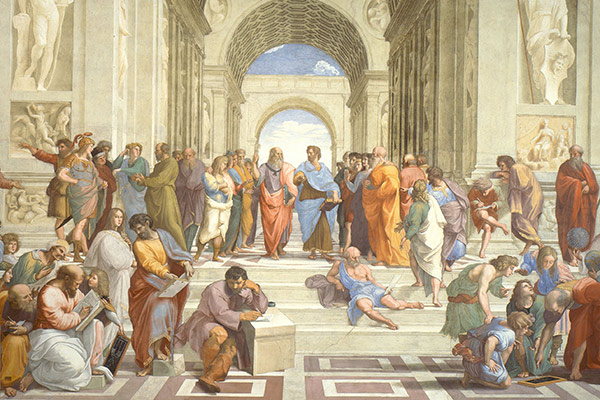
Raffaello Sanzio da Urbino,The School of Athens (detail) Public Domain
The kind of learning we are doing within the New York City public school system is quite different. I knew this; now I know it more than. To make my children's assignments happen, for their promise of getting to the next grade next year, right now – immediately – I have to half-learn things to which others have given many years of endeavour: the Common Core, its very specific pedagogy for math, the intricacies of scientifically measured reading comprehension. Do I have the judgment to evaluate these pedagogies correct now? Absolutely not. In the midst of action one must carry on, in that location's no time to mess around debating the premises I tacitly agreed to a while back when I sent them to public schools. But I practise know that their teachers, people I know and respect, took years to perfect their practice and their understanding of these techniques.
My sons' math problems do not want only the answer to the perplexing situation of someone who had twenty-9 marbles, let eighteen of them get, and has a certain number remaining. Rather, they must show their work with some kind of variable gear up of visual tables of hundreds, tens, and ones, or a number line, or a graph. All of these come up with obscure exhortations to strategize in some particular way, and document the strategy. We need to do this showtime typing and then handwritten, and then we take a picture of it, upload it, and then click an extra box or ii to turn information technology in. I sound lame complaining about this. If only all of my attention could get to figuring it out . . . just I can't learn another person's chore while remaining defended also to my own. Our schoolhouse organization canceled the yearly end-all testing for elementary students; I am glad to not worry about trying to teach to that examination, at least. But then the math-problem problem is renewed each twenty-four hours. And at this point, yous start thinking nearly that elusive leisure over again. What would it even await like? Homeschool, in some abode beyond our home.
And at this point, you lot start thinking virtually that elusive leisure again. What would it even look like?
In Dorothy Canfield Fisher'southward 1916 novel Understood Betsy, the simple-school heroine is suddenly uprooted from the town and sent to country cousins in Vermont, where she has to acquire to get past the idea that chores are for "hired men," and are rather for people, like herself. For her this idea is at first a scrap of a stretch. She'd been taught that education is a rarified matter, one properly experienced as tender feet via competition with classmates, and not some immediate task that obviously contributes to the common household skillful. In the story, she gets over it; merely it takes a while. In one scene, Betsy boasts to her cousins that she knows all about the laying of asphalt, something they've never seen. Simply information technology soon becomes apparent she tin't relate the sequence of how it's laid, on what, by what – not simply because she never really paid attention, but also because she's so ignorant of doing whatever artisanal task that the complexity of the sequence and its causal concatenation lies beyond her imagination (she'd have serious problems while taking college metaphysics). Her first morning at the farm, she stays in bed till she realizes no one is coming to wake her up.
Canfield Fisher also detailed in nonfiction the desire for meliorate things; A Montessori Mother describes her 1911 visit to Casa dei Bambini, and she was one of the most enthusiastic proponents of Montessori's work in America. In the book, she traces the resolution of her ain qualms and suspicions of the method, in the hopes of persuading her fellow parents not to reject the philosophy out of hand. Just it'southward Understood Betsy that offers the more difficult hope of persuading children themselves to take note of the living sort of knowledge of yourself that is itself a delight, the kind y'all take when you don't take to inquire someone else to push your shirt – that is, if children were taking any additional improving book recommendations at this time, which mine at to the lowest degree are not.
What my children need is not to learn the Mayan number system, but to larn how to have out the trash.
Philip Larkin remarks that "home stays as it was left," which is very true, until you make clean it up. If schoolhouse were actually at home, if home were the schoolhouse, it would be obvious, and pressing, as it actually is correct at present, that what my children need is not to larn the Mayan number system, only to larn how to accept out the trash. And assist with the dishes. And the laundry. What would it even hateful if they could learn to sweep? Help make clean the bath, the toilet. Really flush the toilet, every time? (They did learn, initially, so their schoolhouse got automatically flushing toilets, and they stopped, seemingly forever.)
In 2012, the journalist Pamela Druckerman published the bestselling only widely criticized Bringing Upward Bébé, on the surface another incommunicable ode to how the French somehow practice everything amend, but in reality a cursory expect at how a political customs with a better understanding of childcare as a mutual skilful operates on any given weekday morning time. Part of these mornings include children helping with dishes; seemingly obvious advice, only one that columnists were strangely touchy nearly. In the New Yorker review of Bringing Upwards Bébé, the narrator, skeptical of the possibility of benefiting from whatever such cultural alternatives, describes her attempt to let her son bring in the groceries and take out the trash for a calendar week or two, before she got so frustrated with his inevitable mistakes that she decided information technology was easier to do information technology herself, so the experiment ended.
This represents a failure of many things, most certainly of the imagination; one reviewer responded by arguing that the book'south communication ought to be abandoned on the principle that such a system would never produce billionaires. Canfield Fisher in 1916 quite understood i of the underlying reasons for the rejection of Montessori pedagogy: class anxiety. This is the more frustrating to witness, when you besides know that the kind of slow-burning satisfaction of having really fabricated something, or made something piece of work, is a better antidote to stress than most others; and this is true for children no less than adults.
What I'm doing at present from my flat – yet reading and teaching metaphysics and ethics, grading exams, emailing students who oasis't posted anything for weeks, and doing it badly and slowly too, just getting paid – is possible and explicable on no other terms than that my children already know how to make themselves breakfast and lunch, and charily, accept some advice most certain matters pertaining to dinner. The youngest boldly boiled corn for u.s. the other solar day, his Platonic ideal of a vegetable. Nevertheless, what I'1000 still struck past is the sheer book of things I haven't yet, somehow, taught my children to exercise. Certainly they know, in the abstract, that "the trash" must be "taken out." Their sense of the process by which this is accomplished remains hazy in the extreme, like the chiliagon, the grand-sided effigy i can imagine, only never recollect. This is my fault. I take been thinking near something else.
In our Francophonic charter school, founded by and run for West African immigrants as a transition without give up towards the Anglo world in which the students are growing up, my youngest son'south instructor ends each Zoom session with communication he'south uncharacteristically enthralled by. "Clean upward after yourself," she says, in English, this time round. "Organize your room. Assist your mother with the dishes. Help your mother melt!" One kid responds: "I made pancakes!" Some other, from his now-cascading Zoom window: "I want to make a pancake!" And so it's simply Zoom cacophony for a while. My youngest son does not want to learn how to make pancakes right now. His attentive imagination but ran somewhere completely different: He wants to try out some microwave popcorn, burning it, but with the sheer delight of microwave. Popcorn. That he fabricated. Sort of.
As Fröbel puts it, "Come, let us alive with our children!"
This is schoolhouse that is home. And my attention is completely arrested by it: information technology is, after all, beingness. Metaphysics is a subject you report, and it's also a human being; your beingness, if y'all can pause enough to take a look. The human kid is unfinished, a condign towards its being, so fundamentally harder to know; and yet to refuse to learn well-nigh learning, and to larn about the kid's learning, to turn down to re-bend yourself back to the most elementary places where existence and learning live, is to abdicate the peculiarity of existence man, non to mention yourself. Every bit Fröbel puts it, "Kommt, lasst uns mit unsern Kindern leben: come, allow united states of america live with our children!" Come, let us look at our navels, and at our kitchens; there are gods here too.
Source: https://www.plough.com/en/topics/community/education/the-home-is-the-school
0 Response to "â€å“from Plato to Podcasting and Back Again Lydia French"
Post a Comment